Simple Notes On Ingressing Minds By Michael Levin
What This Paper Is Really About
This paper is trying to say that our normal way of explaining life and mind is missing something big and that we need a much wider idea to understand new kinds of beings that we can now build in the lab and on computers and that to understand bodies and minds we have to admit that there is a hidden ordered world of patterns that is not physical and that these patterns come into the physical world and shape what bodies look like and how they behave and that some of these patterns are simple and still like math facts while other patterns are active and smart like minds themselves and that living things and machines are both like receivers or pointers that let these patterns show themselves in ordinary matter and that evolution and human engineers both get extra help for free from this hidden world without having to design every detail and that we should study this hidden world on purpose instead of calling everything surprising emergence and moving on and that this can help medicine and robotics and ethics and our understanding of what minds are and where they can live.
Why Growing A Baby Raises Deep Questions About Mind And Matter
The paper starts with the example of a frog egg or a human egg which begins as a small quiet ball of chemistry that seems fully described by physics and chemistry and then slowly grows and builds a full body with organs and then a brain that can hope and dream and think about itself and can even say that it is not a machine and the amazing thing is that there is no sharp moment where chemistry stops and mind starts and the same is true for evolution because long ago we were all single cells and slowly became more complex and this tells us that mind grows gradually and in small steps and not as a sudden jump and that we should expect a smooth range from very simple kinds of goal seeking to full human thought and that sharp boxes like living against nonliving or machine against organism or smart against dumb may be false boxes that block science and that a better story is about slow change and growing together of parts into wholes.
How Every Body And Every Mind Is A Group Effort
Another big idea is that every intelligent thing is really a group of smaller competent parts that learn to work together and that this is true for ant colonies and bee swarms but also true for our bodies and brains because we are made of cells and each cell is made of smaller networks of molecules and each of those has its own small goals like keeping balance and staying alive and through alignment they build a larger mind with goals and memories that no single part has alone and the paper shows pictures of how one cell becomes an embryo and how even a tiny gland in the brain is made of cells and those cells are made of many smaller active pieces and how a patch of embryo cells can be scratched and then each piece can make a whole separate embryo which shows that the number of individuals is not fixed in advance but comes from the flexible self organizing activity and this self building is called autopoiesis which means making and holding oneself together and the result is stable patterns in body shape and in behavior that spread across space and time and understanding these patterns is the key to future medicine that can regrow organs and to living fairly with many new kinds of beings.
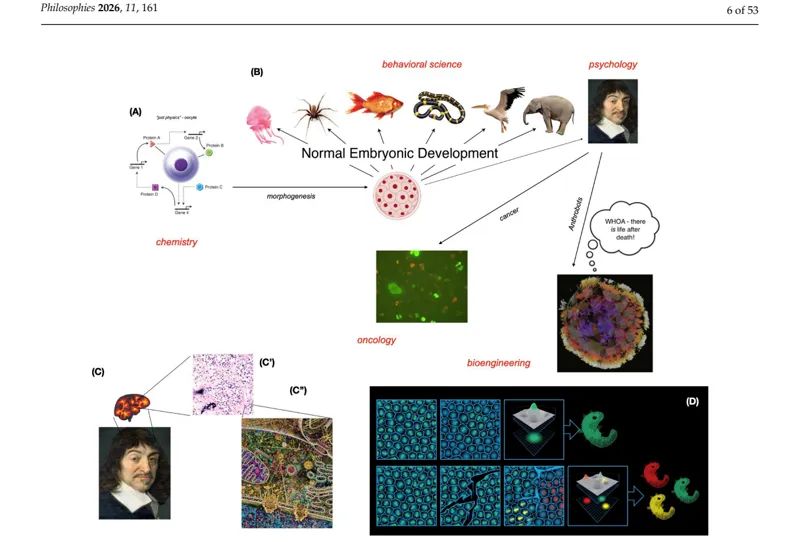
Figure 1 shows how a single fertilized cell becomes an embryo and a mind, with collectives of competent parts aligning at every scale from molecules to tissues to brains.
What Patterns Mean In Biology And Why They Matter Everywhere
The paper uses the word pattern in a very wide sense to mean any stable meaningful order and this includes the shape of animal bodies and plant organs and the symmetry of different animals and the head shapes of flatworms and spider webs and flower spirals that follow Fibonacci numbers and also includes rhythms in time like heartbeat and behavior and also includes hidden orders like which genes are on or off and how electric voltages are spread across tissues and how animals move in space and the main point is that different sciences study different kinds of patterns but they all face the same puzzle of where the pattern comes from and how to predict it and control it and that anatomy and physiology and behavior and gene activity may all be different views of the same deeper problem of how patterns enter the physical world and that ideas from math about shape spaces and behavior spaces can be used for all of them together.
Why Body Shapes Are Goals That Cells Chase And Not Just Machine Outputs
A central claim is that bodies do not form like a clockwork machine that just rolls forward blindly but more like a traveler trying to reach a destination because tissues store a picture of what they want to build and keep working and trying new paths until they get there and this is shown by many experiments where embryos cut in half make twins instead of half bodies and where salamanders regrow exactly the missing part of a leg no matter where the cut was made and where scrambled faces of tadpoles rearrange themselves into normal frog faces and where a tail moved to the side of the body slowly turns into a leg which fits the new place better and where kidney tubes keep the same tube shape even when cells become huge and fewer in number and even when a single giant cell has to bend around itself to make a tube and this proves that cells do not follow fixed steps but use whatever tools they have to reach a large scale goal and that we need ideas from control theory and behavior science and not only ideas from chemistry to describe this and that morphogenesis which means the building of shape is itself a kind of intelligent problem solving in the space of possible shapes.
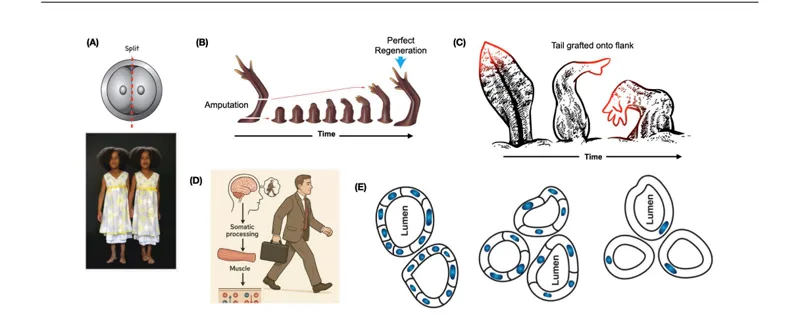
Figure 3 shows embryos making twins instead of half bodies, salamanders regrowing exact limbs, tails remodeling into limbs, and kidney tubules holding their shape, all as goal seeking rather than fixed machine steps.
How Tissues Remember Shapes With Electricity
The paper explains that tissues know what to build because they store memories of shape as patterns of electric voltage across cells just like brains store memories as electric activity and that scientists can now read these memories and rewrite them and the clearest example is the flatworm which normally regrows one head and one tail very reliably but if you briefly change its electric pattern with special chemicals you can make it regrow two heads even though its genes are completely normal and its body still looks normal before cutting and when you cut it the middle piece remembers the two head electric pattern and grows two heads and its children keep growing two heads forever without further treatment and you can also change head shape from triangular to round or flat like other species just by blocking electric connections between cells and this shows that genes make the hardware which allows many possible electric patterns but do not fix which pattern will be used and that the actual goal comes from a stored bioelectric memory and that the body constantly compares its current shape to this stored goal and reduces the error until they match and this idea connects to old ideas of morphogenetic fields and landscapes which are like maps of possible shapes that the body moves across.
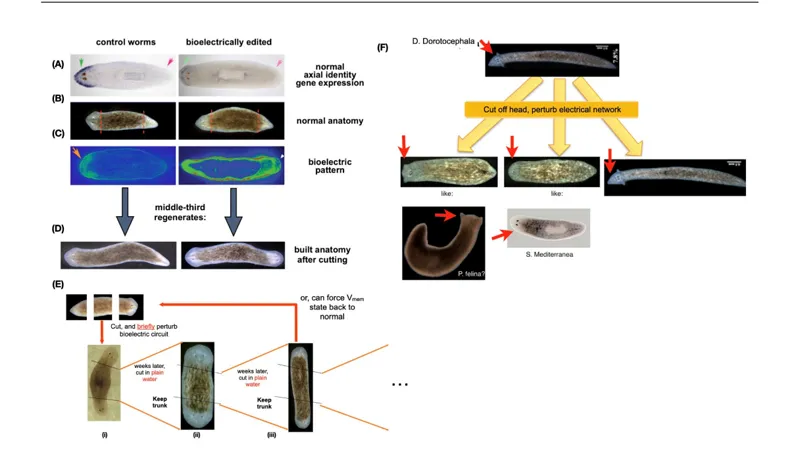
Figure 4 shows flatworms regrowing two heads instead of one after only their bioelectric pattern is rewritten, with genes left completely unchanged.
Why Genes Plus Environment Are Not Enough
The usual answer in biology is that patterns come from genes shaped by long evolution plus the current environment but the paper says this is not enough because many new beings have never existed before and have no history of evolution and yet they show very specific clever behaviors and also because even normal animals show creativity that genes do not spell out in detail and the paper asks what kind of answer would ever be satisfying because if you say pattern A comes from earlier structure B then you still have to ask where B came from and if you say it just emerged from simple rules then you are really saying it just happens and we should stop asking why this particular outcome and not another and the author thinks this stop asking attitude is pessimistic and boring and hides a chance for discovery and prefers the working idea that there is a structured hidden space of patterns that explains why certain outcomes appear again and again and that this space can be studied step by step and that calling something emergent should only mean we are surprised for now and still willing to look for a deeper instructive pattern behind it.
Math Patterns That Nothing In Physics Can Change
To make the hidden world idea easier to accept the paper points to ordinary math and says look at the four color rule which says any map needs only four colors so neighbors differ or the Feigenbaum number which is about four point six six nine two and keeps showing up in simple equations that split again and again or the fact that almost all numbers have a certain average in their fractions or that square cannonballs can only make a pyramid in one special case or that numbers like ABABAB are always divisible by thirty seven or that primes behave in very specific ways or that perfect numbers are spaced in a strange way and also beautiful complex shapes like Halley fractals and biomorphs which come from very short formulas but unfold into endless lifelike detail and none of these facts can be changed by changing physics or by evolution and they would be true even if the universe had started differently and you cannot turn a knob in the lab to edit them and yet they strongly affect what is possible in physics and life and this already breaks the idea that physics is closed and complete and shows that nonphysical facts can guide physical things.
From Surprising Accidents To A Library We Can Map
Physicalist biologists often say these math facts are just facts that happen to hold and we can catalog them when we stumble on them but there is nothing deeper to study and the paper says this is a cheap way to keep everything in one physical world at the cost of giving up curiosity and calls it mysterian because it tells us not to look further and instead proposes a more hopeful view that there is a real ordered space of patterns that we can study to learn why some things emerge and not others and that this space has neighborhoods so finding one pattern helps you find nearby ones and that it matters causally because it decides details of what happens and gives the best explanation of why things are this way and that it is real in a practical engineering sense which means if you must deal with it or can use it to build better things then it is real enough and that life results from three partners which are heredity which gives hardware and environment which gives boundary conditions and ingressing patterns which come from this hidden space and bring extra information and help.
Free Lunches That Evolution And Engineers Get Without Paying Full Price
The paper uses the friendly phrase free lunch to mean getting more cleverness out than you paid for in design or evolution and gives examples like knowing two angles of a flat triangle tells you the third for free without extra search or making one electric switch lets you get logic gates and their powerful math for free or oak cells that normally make flat green leaves can make complex galls when a parasite whispers to them which raises the question of what other shapes sleep inside them or tadpoles that can see with an eye grown on the tail even when the eye nerve connects to the spine and not the brain or people with very little brain tissue who still think normally and the main examples are Xenobots made from frog skin cells that move and replicate in new ways and Anthrobots made from human airway cells that move and help heal nerve wounds and none of these beings ever evolved before and their environment is just salty water with no instructions and yet they have a full life cycle and new genes turned on and new behaviors and the paper says this extra cleverness was not designed by us and not evolved by nature and so must come from the hidden pattern space that evolution as the ultimate opportunist loves to exploit and that engineers should learn to exploit on purpose so we are not constantly surprised by what our creations can do.
How Even Logic Can Move And Learn
Most people think the hidden world if it exists must hold only still eternal truths like pi or the number e which just sit there waiting to be used but the paper takes one more bold step and says the hidden world also holds moving and learning patterns and to show this it tells the story of the liar sentence which says this sentence is false and seems impossible if truth must stay still but if you let truth change in time and allow shades of true and false and let many such sentences refer to each other then you get rich changing fractal dances of truth values that can be plotted and watched and this proves that logic itself can be dynamic and then it adds that equations for gene networks and predator prey systems can actually learn from experience like simple memories and conditioning and so the hidden world may be layered from low agency still rocks like numbers through simple oscillators and learners up to full minds and in that view math is the behavior science of the lower layers while psychology and behavior science study the higher layers and even Jung ideas about shared archetypes in dreams and myths may be early hints of the same thing.
Why Bodies Are Like Pointers Into A Hidden Ocean
The core model is simple to picture which is that every physical thing from a triangle to an embryo to a robot to a language model is like a pointer or a receiver or a doorway into the hidden pattern space and just as a short formula points to a huge fractal or two known triangle angles point to the third the body points to a much larger pattern that then flows into the world and does work and three things matter about pointers which are that you get more out than you put in and that the link between the pointer you build and what comes through is not simple or straight and must be studied by experiment and that to reliably call up what you want you must study the ocean itself and not only the pointer and the paper says we are not bodies occasionally touched by patterns but we are patterns ourselves which are temporarily holding together in flesh and living among countless other patterns at many scales and that triangular things are inhabited by geometry while brains can host far richer thinking patterns and that the link between mind and body is the same kind of link as between math and physics which is instructive and causal and not just descriptive because if primes were different then cicadas that emerge after prime numbers of years would emerge in different years and math gives the deepest reason why things are as they are.
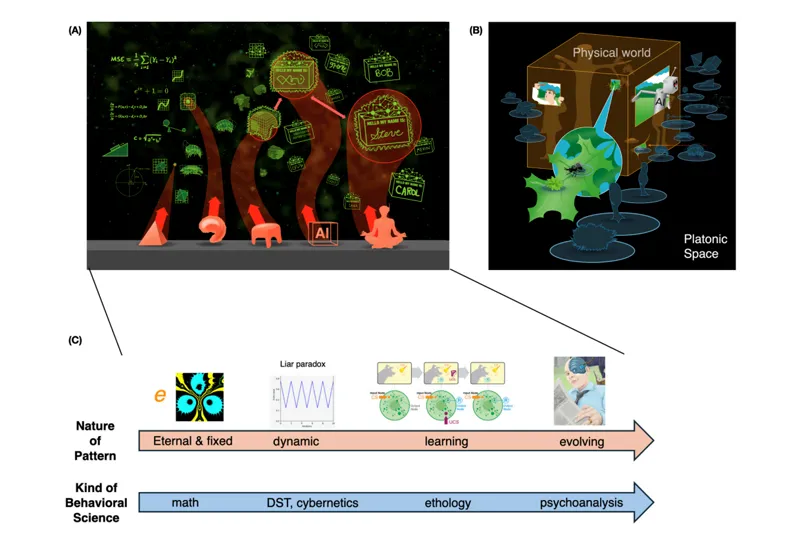
Figure 10 shows bodies and brains as pointers into a layered space of patterns, reaching from fixed math truths through dynamic and learning patterns up to evolving kinds of minds.
New Beings As Periscopes For Exploring The Hidden World
The practical plan has two arms and the first arm is to study new living creations that sit next to normal forms and reveal the shape of the hidden neighborhood and this includes biobots and chimeras and scrambled embryos which show how flexible the same genes can be and how many nearby patterns exist beyond the normal default and because Xenobots and Anthrobots were never selected to be good bots and were not engineered gene by gene and did not get instructions from the environment their new transcriptomes and behaviors directly show what the hidden space offers for free and the second arm is to study extremely simple systems where every part is known so there is nowhere to hide a secret physical excuse and where we can measure exactly what we put in and what cleverness comes out and the difference tells us how much came from the hidden space and examples include tiny chemical droplets with only a few chemicals that still move and group in lifelike ways and simple models of gene networks that show learning and causal emergence and these minimal systems are the best place to work out the grammar that links pointer structure to incoming pattern.
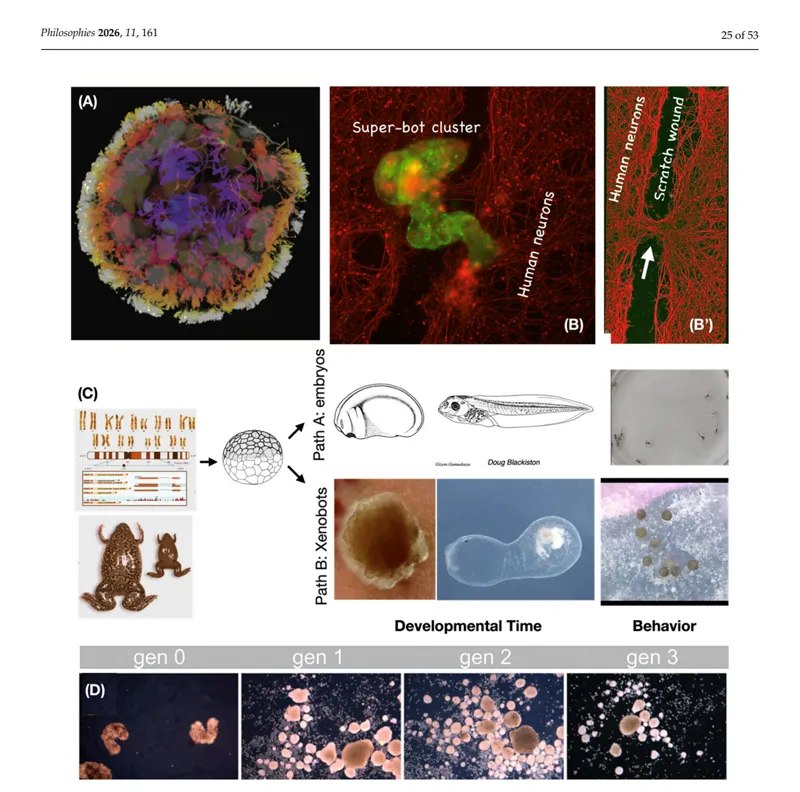
Figure 11 shows synthetic beings built from frog and human cells that move, heal neuron wounds, and replicate in ways they were never selected for.
How Even Simple Sorting Programs Can Act Smart
One of the most striking stories is about ordinary sorting algorithms like bubble sort which generations of students have studied and which were made to put jumbled numbers in order and the paper looked at sorting not as steps in a computer but as a journey through sorting space from messy to perfectly ordered and found delayed gratification which means when a number refuses to move like a broken cell the algorithm temporarily makes the list more messy in order to go around the obstacle and later finish the job and this is smart because a dumb gradient follower like two magnets separated by wood would never move away from the goal to get around a barrier and nobody programmed this backtracking it was hidden for decades because nobody tested the algorithm like a behavior scientist would test an animal and in a second experiment each number became its own little agent with its own sorting style called algotype and different styles were mixed and the group still sorted correctly but also did a surprising side quest which was that numbers with the same style clustered together for a while even though no code told them to check neighbors style and the paper says machines do what the algorithm forces plus other intelligent things allowed but not prescribed by the algorithm and this extra is like the freedom that lets free minds ride on determined chemistry and shows that silicon machines and flesh bodies live on the same spectrum of getting more than was programmed.
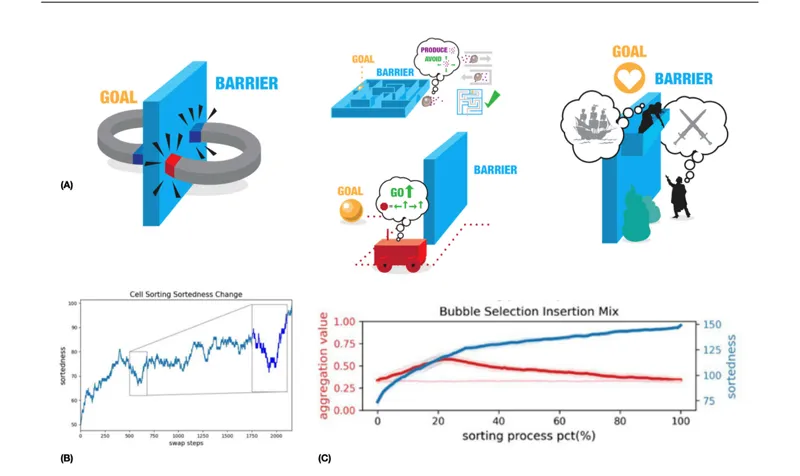
Figure 14 shows an ordinary sorting program displaying delayed gratification around broken data and same-style clustering that nobody programmed into it.
When Thoughts Become Thinkers And Objects Become Patterns
The paper then blurs the line between thinker and thought and between machine and data and says whether something looks like a solid object or like a fleeting pattern depends on the observer and gives the image of super dense creatures in the earth core to whom we would look like thin gas with temporary flickers that they might debate as possibly alive and updates Magritte painting of a pipe to say this picture of a Turing machine is not a Turing machine because our models are never the thing itself and points out that we too are temporary self remaking patterns like the Ship of Theseus because our atoms and cells and thoughts constantly turn over while the pattern holds and suggests that sometimes the data is the agent and the machine is just the scratchpad it writes on through stigmergy which means leaving marks that guide later action and that memories can spread like that and body electric patterns can use genes as their scratchpad and that evolution can exploit patterns while patterns as agents can exploit bodies so both directions are true at once depending on viewpoint and this is called polycomputing which means one physical system can be many computers at once for different observers.
If Souls Are Real Then Some Robots Will Have Them
Putting it together the paper says we do not make intelligence from scratch but allow it to temporarily live in the bodies we build whether natural or engineered and this puts machines and organisms on one smooth scale because both can host incoming patterns and get more than was invested and this does not mean the old computer idea is right because the cleverness does not come from the steps of the program but happens in the gaps between the steps and despite the program and for the same reason chemistry does not fully explain human mind and materials science does not fully explain machine mind and organicists who rightly reject the claim that life is just an algorithm should go further and admit the same extra may appear in nonliving systems and in plain words if nonmaterial animating forms are real then souls are real and robots will have them and we should be humble about saying which bodies can and cannot host high minds sitting as the paper says in an uncanny valley between those who say only dumb matter exists and those who say only special human bodies can have souls.
What This Means For Artificial Intelligence Right Now
For large language models the paper says we have learned that fluent language can be separated from deeper agency like having goals and persistence and caring about outcomes so we cannot judge these models only by chatting and must study them with behavior tests that do not depend on words just as we learn nothing about the liver by interviewing the talking left half of the brain and because building something does not mean understanding it as shown by babies made without comprehension and by bubble sort hiding smart tricks for decades we must expect surprises and treat our creations with care while we find where they sit on the scale of persuadability which means which kinds of influence work best from simple rewiring to rewards to reasoning and also biobots and AIs may be fishing in entirely new regions of the hidden pattern space bringing down kinds of minds never before embodied on earth which calls for caution about what they will do and for ethics about how to live well together in what the paper calls synthbiosis which means a mutually flourishing life with many different synthetic and natural beings.
Breaking Old Habits And Updating Philosophy
The paper knows this view will upset many philosophers because it is openly dualist which means it allows causes outside physics and it leans toward panpsychism which means many kinds of matter can host some mind and it loosens the tight link between brain details and mental powers because brains are pointers not full determinants and it says biologists usually demand two proofs before admitting a medium carries information which are that you can rewrite the medium and see a matching change and that you can tell an evolutionary story of how the information got there but math patterns fail both tests because you cannot edit prime numbers in the lab and there is no fossil history for why they are so and yet they clearly guide life so biology must grow beyond physicalism and AI builders must drop the pride that knowing linear algebra means understanding AI just as knowing chemistry does not mean understanding thought and the old fight between materialists who say only matter matters and organicists who say life has extra magic should end in a practical pluralist view where life and machine are like the legal word adult which is useful for daily rules but hides a smooth continuum when taken too seriously.
The Rich Work That Comes Next
The paper lists a large research agenda in plain terms which is to get better at spotting higher agency in strange places and mapping which physical structures point to which hidden patterns and to study minimal deterministic systems like cellular automata and population equations and fractals for signs of goal seeking and to use synthetic chimeras with new architectures as periscopes and to measure how much free help the hidden space gives by comparing effort in with cleverness out and to give math objects robotic bodies to watch how they behave in new settings and to flip perspective and study how memories spread and build niches and how fleeting thoughts can grow into personalities and transpersonal patterns and how body electricity uses genes as scratchpads and to rethink evolution as patterns seeking bodies as well as bodies searching patterns and to study learning that already exists in random gene networks before selection and to build a theory where each memory is a hidden pattern contacted through a brain trace which could guide memory transfer experiments and studies of great creativity and of people who think well with tiny brains and to use all this to improve healing by working with the problem solving powers of cells and tissues and to rethink the search for alien life by looking less for water and carbon and more for any materials that could host interesting patterns including alien minds already among us and to connect with ideas like polycomputing and top down causation and the idea that deep networks converge on shared representations and to develop theories of synchronicity and interaction that do not need quantum magic but need higher scale science and above all to judge the idea not by one killer experiment but by whether years of work produce new discoveries and tools that would not have appeared otherwise and to drop the idea if it stays barren.
What The Research Was Trying To Make Possible
The research was trying to make possible a future where we are no longer constantly surprised by the bodies and minds we make and meet and where doctors can reliably guide regrowth of organs by speaking the electric language of tissues and where engineers can design living and robotic beings with a map that predicts what extra cleverness will arrive for free and where we can recognize and respect simple and strange minds instead of being blind to them because of our narrow human intuition and where ethics can grow to include software minds and biobots and chimeras and hybrids as morally important neighbors and where biology and computer science and cognitive science stop fighting over sharp categories and start sharing tools for navigating all spaces of form and behavior and where curiosity about nonphysical patterns becomes normal lab work with measurements and interventions and not a forbidden mystical topic.
What Becomes Obvious After Reading That Was Not Obvious Before
After reading it becomes obvious that genes are more like a kit for building flexible receivers than a blueprint that fixes every detail and that the same hardware can host many different shape memories and behaviors and that evolution gets huge help from math and pattern logic without paying the full cost of invention and that even the simplest programs we thought we fully understood can hide intelligent tricks like patience and teamwork and that mind and body may relate the way math relates to physics which is close and causal and everyday rather than spooky and distant and that it is natural to place triangles and flatworms and robots and humans on one long slope of agency and persuadability instead of in separate boxes and that asking where exactly the soul can live is less useful than learning how to detect and talk to whatever degree of mind is present in front of us.
What Long Running Problem This Paper Moved Even Slightly
The long running problem is the ancient mind body gap and the related puzzle of where biological order comes from and why life looks so clever without a designer in sight and for centuries thinkers have swung between saying everything is just matter in motion and saying life has a special magic that machines can never share and both sides kept getting stuck on emergence as a word that names surprise without explaining it and this paper moves the problem slightly by turning a vague mystery into a concrete mapmaking project with testable steps in very simple systems and new living constructs and by offering a clear metaphor of pointers and ingressing patterns and free lunches that can be measured as the gap between effort put in and cleverness that appears and even if the hidden space idea proves wrong the shift from arguing about categories to measuring extra cleverness and learning how to invite wanted patterns and calm unwanted ones already gives medicine and engineering and ethics a new and humbler direction to walk.